
Your company is considering signing a contract that will shape the retirement of every one of your employees. Our experience shows that many Employers and Provident Fund Management Committees don’t have a structured approach in their evaluation process.
Six questions to ask before you initiate the provider selection process
- Is the employee base going to benefit from this change, or are they better suited to remain as is? How does your current set-up compare relative to the commercial options and what are the main changes for your employees?
- How will you evaluate various providers? Are you aware of the key differences between them?
- What design considerations can you influence, and how can these impact your plan?
- What ongoing actions are required to ensure that the Plan operates smoothly and is appreciated by your employees?
- How will this contract be monitored from the Employer’s side?
- In case of multiple providers, who will be responsible to prepare and present the performance of the providers to the members on a comparable basis?
Cyprus Provident Fund landscape - What has changed?
In 2020 the introduction of a new law raised the governance bar for Provident Funds, and the Regulator’s 2021 Directive on DC plan transfers followed. Since then, the number of Provident Funds in Cyprus has dropped sharply as plans have been steered into Multi-Employer Provident Funds and Group Pension Insurance policies. Much of this clean-up was overdue, because many of those funds were too small ever to meet their regulatory obligations.
What often gets lost in the move is this: signing with a provider is where your responsibility begins, not where it ends. The choices you make now, and how closely you follow what happens next, will decide whether your employees retire with the savings they deserve or face an unwelcome surprise.
Decisions that shape outcomes for members
Moving to a product is not simply a change of administrator. It is a chance to rethink how your retirement plan is designed, and the choices made at this stage have a lasting effect on your members retirement.
Many single-employer Provident Funds have had a lower cost base than commercial products over the years and a single investment strategy for all members. A single strategy can look like a weakness next to products offering a menu of investment options. In practice, it has often served members well as a Committee of a well-run Provident Fund along with the support of their consultants is better placed to avoid common pitfalls and take informed decisions considering the plan membership and expectations. Experience in Cyprus and internationally shows that when given investment choice, many members:
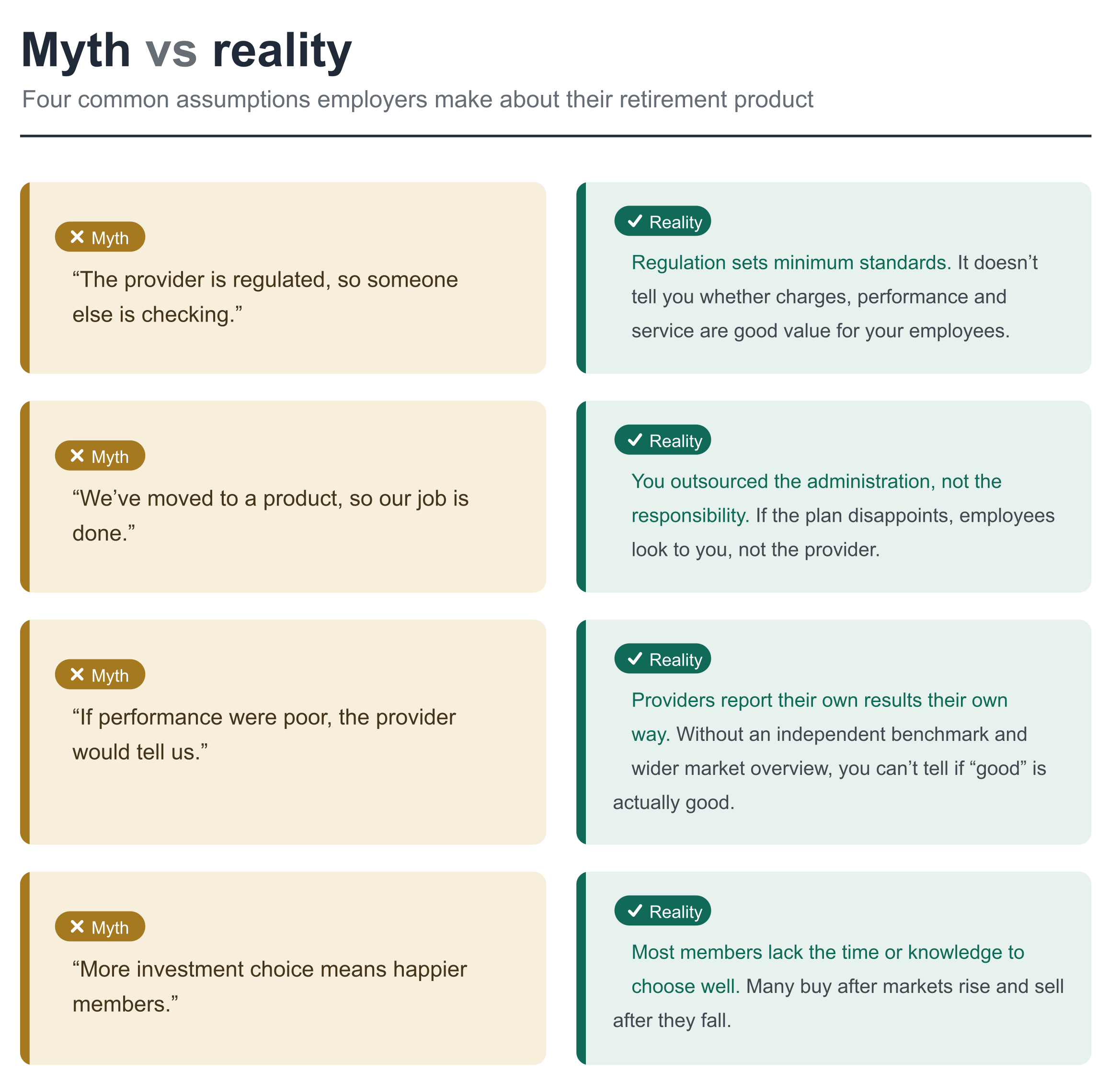
- don’t have the knowledge needed to choose between options with confidence;
- don’t spend the time to review their choice regularly, or ever;
- are swayed by the wrong things, such as recent market headlines, and buy after markets have risen or sell after they have fallen;
- are inactive, staying with the default option or their initial choice made at the start of the plan.
Many products also let members switch between options at any time at no cost. Flexibility sounds attractive, but it encourages members to try to time the market or react to market events rather than plan for the long term, and the result is typically detrimental to their retirement savings.
The above should be taken into consideration when evaluating a structural change to your retirement plan offering. No one solution is right for all. Committees and Employers owe it to their members to carefully assess what the best option is for them.
Careful provider selection, with independent advice
Commercial retirement products in the Cyprus market differ widely in supervision, legal structure, charges, investment options, administration & communication platform, and governance. Comparing them is not simple. Charges are structured differently, performance could be reported on different basis, and important details may be in the small print.
Providers will naturally present their own products in the best possible light. That is why the selection process should be supported by an independent advisor. An independent advisor will:
- set clear selection criteria based on your objectives, not a provider’s sales pitch;
- gather and compare proposals on a consistent, like-for-like basis;
- assess investment options, and highlight any material differences;
- review contract terms;
- document the process, so the employer can show the decision was made carefully and in members’ interests. The process followed and information prepared as part of the selection process can be used to satisfy the regulatory requirements for the transfer of accumulated balances as defined by the 2021 Directives on the transfer of benefits.
The provider you choose now will look after your employees’ retirement savings for years, hopefully for decades. That decision deserves the same rigour as any other major business contract.
Common myths/pitfalls that Employers run into:
- “We’ve moved to a product, so our job is done.” Is it?
Moving to a product relieves Management Committee members, who are often employees of the Sponsoring Employer (without additional remuneration), of a considerable administrative burden. Many employers then assume their involvement drops to zero. We strongly encourage them to see it differently. - This is a long-term contract with a provider.
Your company wouldn’t sign a multi-year contract with any other key supplier and then never check whether it delivers what was promised and/or evaluate the vendor. Charges, investment performance and service should be reviewed regularly against the contract and against the market. - The retirement plan is one of your most valuable employee benefits. If it underperforms, if charges creep up, or if members feel lost and unsupported, dissatisfaction follows, and it lands with the employer, not the provider.
- Outsourcing administration is not outsourcing responsibility. Moving to a product should not be a way of handing the responsibility over to employees, leaving each member alone to make complex investment decisions. The employer chose the provider, and the employer remains best placed to make sure that choice keeps serving its people. Selecting provider(s) and then never reviewing them does not fit well with the duty of care employers owe their workforce.
What good ongoing oversight looks like
Oversight doesn’t have to bring back the burden that led to the move. A proportionate framework includes:
- Annual monitoring. Review each investment option’s performance against its objectives, its benchmark, comparable options from other providers and the wider market. Check charges and service against what was agreed and raise issues early. This is particularly important in case the Employer has appointed more than one product provider; plan members should be able to compare between the selected providers on a like-for-like basis. Appointing an independent firm to support the Employer in this comparison is critical.
- Regular member education. Organise sessions where the performance of each option is presented in plain language and set in context against other providers and the market. Help members understand how the plan works and why reacting to short-term market moves is usually costly. Better-informed members make better decisions and value the benefit more. Appointing an independent firm separate from the selected provider to run these sessions can create a forum where any concerns are raised in a timely manner.
How we can help
As an independent actuarial and investment consultancy specialising in Defined Contribution and Defined Benefit plans, we support employers at every stage:
Considering a move? |
We can help you review your existing set-up and evaluate the decision to move or not. In case where a move is preferred, we help design a plan that fits your workforce and run an independent, structured and transparent provider selection, so the decision rests on evidence rather than sales presentations. |
Already moved? |
It is not too late to put proper oversight in place. We provide independent annual monitoring of your provider’s performance, charges and service, benchmarked against the market, plus member education sessions tailored to your workforce. |
Introducing a new plan? |
If you are introducing retirement benefits through a commercial provider, we support you with plan design, market information and benchmarking, and a structured provider selection process. |
Your retirement plan is a promise to your people.
Let us help you increase its value.
Get in touch for a free initial review and discussion
Alexis Yiannas, CFA
Partner
Tel: +357 22 456052
Email:
Email:
